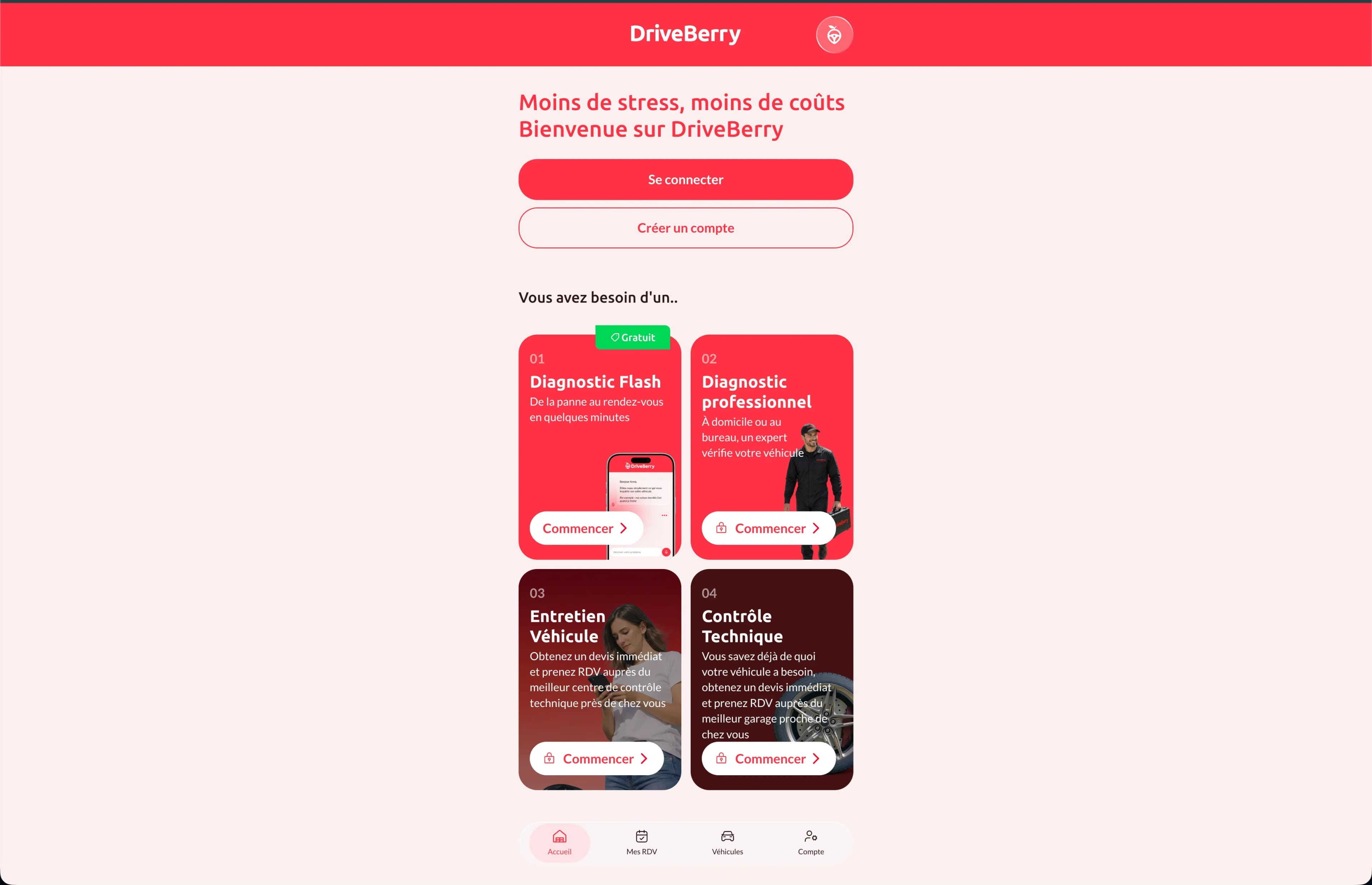
DriveBerry is a car-servicing platform in France, simple to describe yet intricate underneath: right from their phone, a driver works out what is wrong with the car, receives a quote and books a garage, while the garages and their teams run the entire operation - appointments, diagnostics, invoices, finances - through a separate management panel. I built two major parts of this system: the customer app at app.driveberry.ai and the whole operational back office. The main website, driveberry.fr, was built by someone else and lies outside my part of the work. And unlike my earlier projects, this one I built entirely together with Claude Opus, versions 4.6 through 4.8, which I will say more about at the end.
Diagnosis: from plate to decision
The customer app is built around one central scenario: working out what is wrong with the car without leaving home. Everything starts with the licence plate, from which the app identifies the vehicle, after which the driver can refine the details or choose the model by hand. Next comes an interactive diagnosis shaped as a dialogue: the app asks questions, and the driver can answer not only by tapping but by voice, since speech recognition is built directly into the chat - useful when standing over an open bonnet. As the conversation unfolds, a picture of the fault takes shape, and at the end the driver receives a result along with concrete recommended actions. A separate path covers mileage-based maintenance: entering the current mileage is enough to see what needs replacing and servicing.
Booking, valet and payment
Once the decision is made, booking begins, and it is not a single button but a considered, sequential flow: the app helps choose a garage, including by geolocation - which one is nearby - pick a slot on the calendar, and provide an address. A separate feature covers valet pickup and drop-off: the car can be collected and returned, and this is arranged directly within the same flow. Payment runs by card through Stripe, with confirmation and a success screen. Completed bookings live in their own section, each with a detailed card, and their statuses arrive in real time. A guest path is thought through as well: a driver can go through the whole scenario as a guest and later carry that history over into an account, so that nothing is lost.