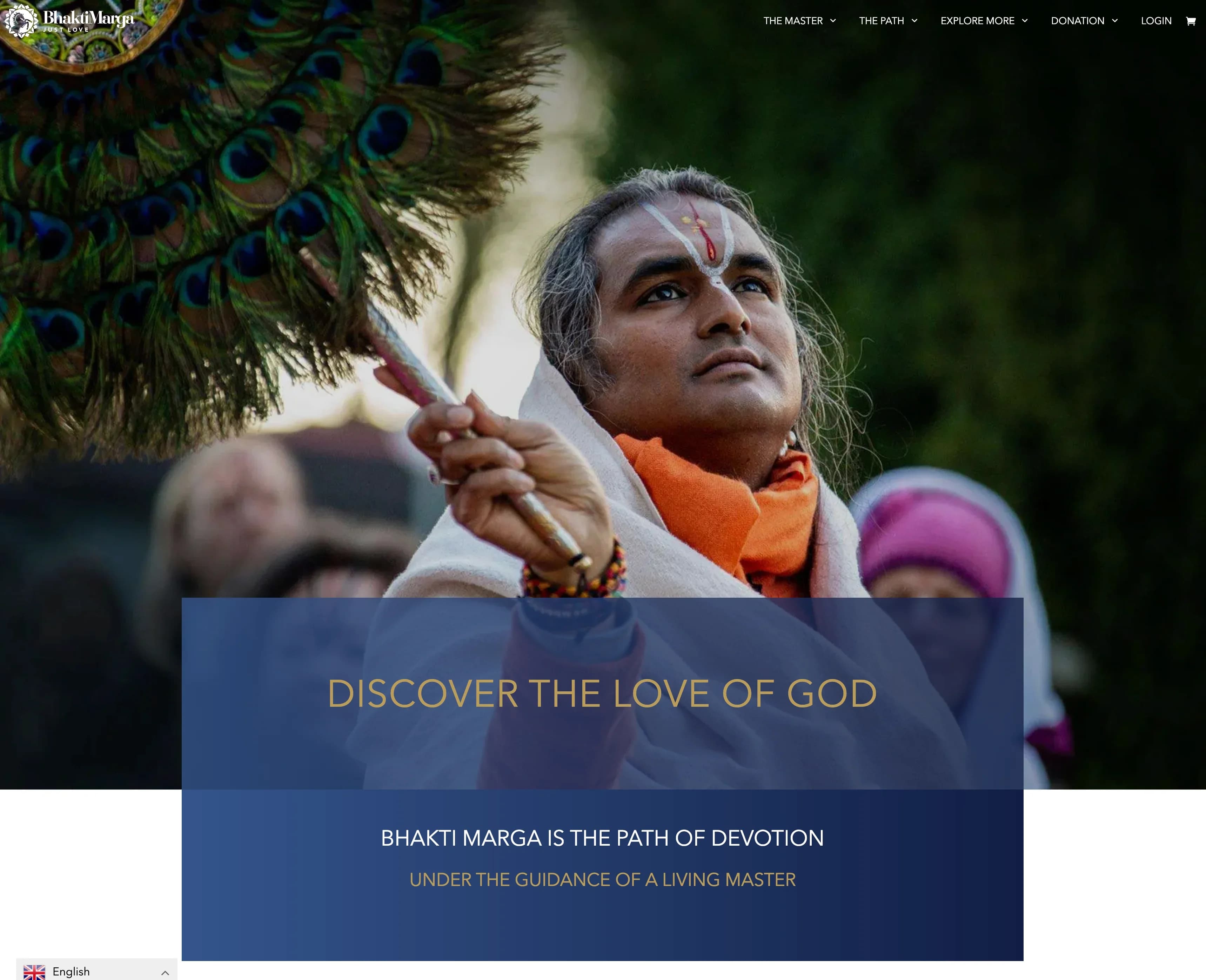
Bhakti Marga is one of the largest projects I have built, and quite possibly the most alive of them all: an international spiritual portal with dozens of sections and a whole ecosystem of services built around a real community that uses it every day.
The architecture: headless WordPress
The most interesting part of the project is hidden under the hood. The backend here is WordPress, which is a genuine surprise for a project of this scale: WordPress usually means a stock theme and a stock site, and here everything works the other way around. WordPress runs headless, remaining only a content management system and an admin panel that editors find familiar and comfortable, while the entire interface lives separately, as an application built on Next.js and React.
GraphQL connects the two halves. The frontend asks WordPress for exactly the data a given page needs and not a byte more, retrieves it through Apollo Client with caching, and renders it on the server for the sake of speed and SEO. The result is a rare combination: people manage the content freely without writing a single line of code, while what ships is a fast, modern, fully custom interface with nothing WordPress-shaped left in it. Splitting the backend from the frontend was a deliberate decision, and it paid off - each half can be developed and scaled on its own, without disturbing the other.
Spiritual life online
The portal is built around a living community, and much of the work consisted of moving its practices online. Online courses, a darshan schedule and live streams, requests for an online darshan and a blessing, om-chanting on request, rituals and devotional arts, pages devoted to the tradition and the teacher, events with the master - dozens of thematic sections, each with its own logic and its own forms. This is not a set of identical pages but a great many different, small products living under one roof.